
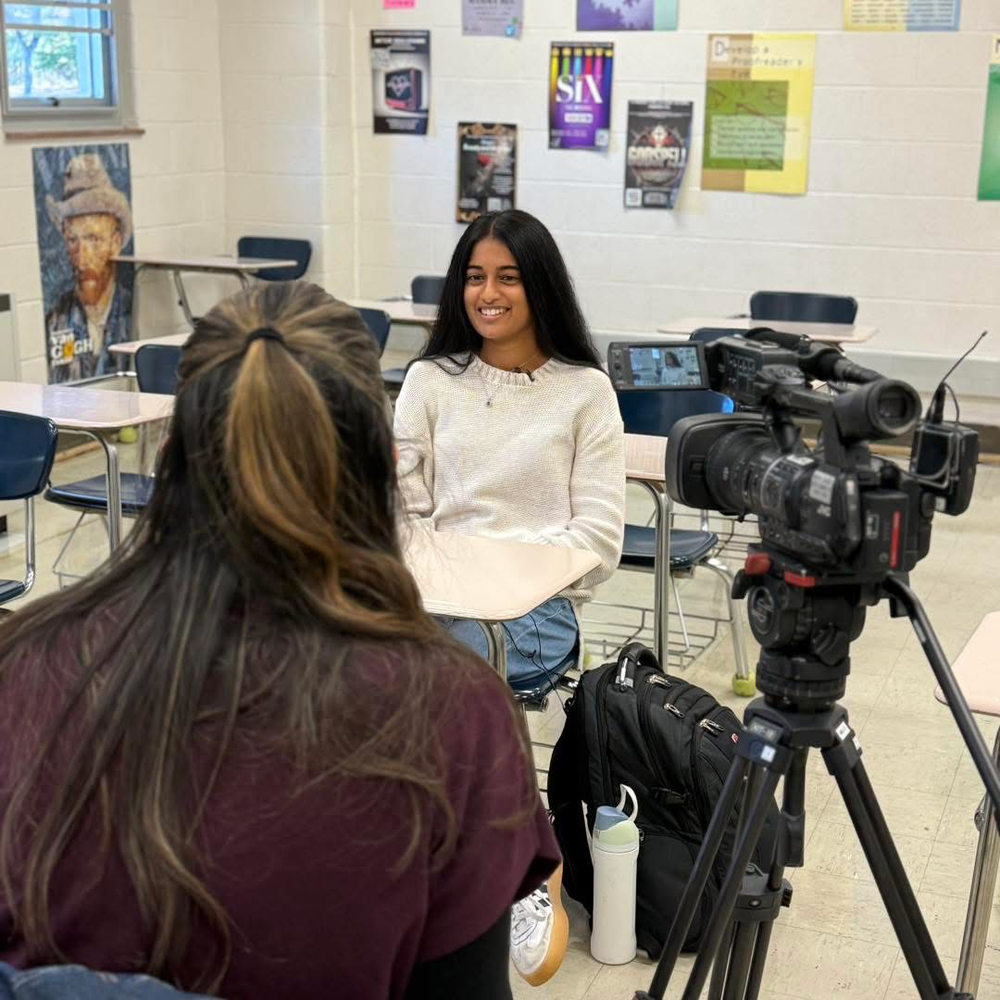
Chagrin Falls High School senior Syna Bhattacharya is taking her passion for science beyond the classroom, publishing original research on antibiotic resistance and developing an artificial intelligence-powered app to help address gaps in lung cancer screening. Her accomplishments recently earned her recognition from Cleveland 19 News and demonstrated how academic opportunities can inspire students to tackle real-world challenges.
Bhattacharya, 17, recently had her AP Research project published in the National High School Journal of Science, marking the culmination of more than a year of research, analysis and revisions. Her study examined how consistently three computational tools identify antibiotic-resistance genes in bacterial DNA. Using 100 E. coli genomes, she compared how the tools classified genes associated with resistance to certain antibiotics.
"My research compares three bioinformatics workflows that read bacterial DNA to identify a particular group of antibiotic-resistance genes," said Bhattacharya. "Reading DNA involves interpreting biological code, and different tools may interpret that code differently."
The three tools agreed on all 99 evaluable genomes, suggesting that the methods produce consistent results under the conditions tested. The findings could help inform future research into faster, DNA-based approaches to identifying antibiotic resistance, although Bhattacharya emphasized that additional studies are needed to establish their clinical accuracy.
Her interest in the subject began during sophomore year in AP Seminar, when she and her classmates researched the societal effects of antimicrobial resistance. "I've always had a knack for biology and I recognized the increased role that computation has in our lives, so I wanted to combine both aspects in my research," she said.
That interest led her to Carnegie Mellon University's Pre-College Computational Biology program, where she gained laboratory experience and learned how computational methods could be applied to biological research.
She also served as a remote research assistant with Harvard University's Department of Organismic and Evolutionary Biology, working alongside two doctoral mentors in Professor Benjamin L. de Bivort's laboratory. Through that experience, she learned to maintain professional research records, organize scientific investigations and develop meaningful research questions.
Bhattacharya further explored her interests as a member of the 2025-2026 Harvard Undergraduate Microbiology Society cohort, contributing educational articles about antibiotic resistance and microbiology.
"AP Research gave me the opportunity to bring together all of these experiences into a single, focused project," she said.
Under the guidance of Chagrin Falls High School AP Research teacher Stephanie Ashkettle, Bhattacharya began her project in August 2025. By April 2026, she had completed a 30-page paper and presented her findings as part of the course. However, her work did not end with the classroom assignment.
Determined to share her findings with a broader scientific audience, Bhattacharya researched potential journals and began submitting her manuscript for publication. After receiving several rejections, she revisited her analysis and substantially revised the paper.
In late July, she submitted her work to the National High School Journal of Science. The journal's peer-review process required additional analysis and revisions, including a detailed 12-page review that she was asked to address within seven days.
Balancing those revisions with college applications, coursework, extracurricular activities and exams tested her organizational skills and determination. "Research demands immense patience and time management," said Bhattacharya.
Her persistence paid off when the manuscript was accepted in September and published in early October 2026. Bhattacharya credits her AP Research experience and Ashkettle's mentorship with providing the foundation for her success. "AP Research was the foundation for this entire project," she said. "Without the structure, mentorship, and support I received in the course, I would not have been able to take my findings to the point of publication."
She added, "Mrs. Ashkettle's guidance was crucial throughout this process. She helped me refine my research question, structure my methodology, and think critically about how to interpret my results."
Bhattacharya's interest in combining science and technology has also led her to develop PulmoSmart AI, an app designed to help individuals determine whether they may be eligible for lung cancer screening and locate nearby screening facilities.
Her work was recently featured by Cleveland 19 News, which highlighted her efforts to address a significant public health concern. Lung cancer remains the leading cause of cancer deaths in Ohio and nationwide.
The app was inspired by research from the American Lung Cancer Screening Initiative indicating that more than 80% of eligible individuals do not receive recommended screenings.
Through PulmoSmart AI, users enter information such as their age and smoking history. The app then provides information about potential screening eligibility and helps identify nearby screening locations.
"People are scared based on judgment or fear based on their next steps. And also, many people don't know they're eligible from the start," Bhattacharya told Cleveland 19 News.
Working with 14 student ambassadors, she has tested the app and reached more than 500 community members. Her efforts earned her recognition as one of 20 Phase 2 finalists nationwide through the American Lung Cancer Screening Initiative.
For Bhattacharya, both projects reflect a shared goal of using scientific research and technology to address healthcare challenges and improve access to information.
Her accomplishments reflect the opportunities available through Chagrin Falls High School's advanced academic programs, where students are encouraged to explore their interests, develop research skills, and apply what they learn beyond the classroom.
What began as an interest in antibiotic resistance during AP Seminar has grown into published scientific research and a separate healthcare initiative that has reached hundreds of people. For Bhattacharya, both projects are opportunities to use her interest in science and technology to address real-world healthcare challenges.
Read the Cleveland 19 News story about Syna Bhattacharya's lung cancer screening app.